Set Up Auto-Pay
Schools that accept online payments can enroll payers in Auto-Pay, offering a convenient automatic payment method that helps reduce the likelihood of late payments.
There are two types of Auto-Pay plans: Auto-Pay based on payment plans and Auto-Pay based on incidentals
-
Auto-Pay based on payment plans covers all charges included within a designated payment plan.
-
Auto-Pay based on incidentals applies to charges that fall outside of any payment plan.
To get started with Auto-Pay, log into Billing management, hover over Billing in the navigation and select Settings. Finally select Auto-Pay from the in-page navigation.
Set up Auto-Pay for payment plans
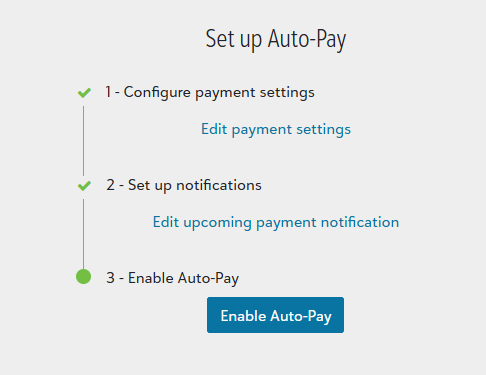
On the Payment plans tab under Auto-Pay, complete the following steps.
 1. Configure payment settings
Configure the following settings, then select Save.
-
Process payments with: Select a payment configuration.
-
Allow credit card payments and Allow direct debit payments: Choose which payment methods payers can use.
-
Charge a convenience fee when paying with credit card and Charge a convenience fee when paying with direct debit: Choose whether to add a convenience fee for each payment method. The fee amount and GL distribution are defined in the billing year's special fees.
-
Allow payers to self-enroll in auto-pay: Allow payers to enroll from the payer portal.
2. Set up notifications
Auto-Pay requires two notifications to be sent to payers: a notification issued two days for US schools before the payment due date, and a confirmation notification sent when the payer is enrolled in Auto-Pay. The process to set-up the email or text alert is identical to other notifications, with two distinctions:
-
The Auto-Pay notifications cannot be disabled once Auto-Pay is active.
-
Only one notification can be created for each Auto-Pay notification type.
Select Set up notifications to customize the upcoming payment and enrollment confirmation notifications.
Read more about creating notifications.
Tip: It is recommended that you include the instructions for putting Auto-Pay on hold in the email to payers.
3. Enable Auto-Pay
Once the payment settings and notification are configured, select Enable Auto Pay, followed by Yes, to allow payers to enroll to Auto-Pay.
Payers enroll in Auto-Pay via the Current bill page. Payers do not see the Auto-Pay section on the Current bill until Auto-Pay is enabled in the system settings.
Set up Auto-Pay for incidentals
On the Incidentals tab under Auto-Pay, complete each step under Set up Incidental Auto-Pay. A check mark appears next to each completed step, and you can select the step's edit link to make changes.
1. Configure payment settings
Configure the following settings, then select Save.
-
Auto-Pay payment date: Select the day of each month that payments are automatically withdrawn for incidental charges due within the current statement period.
-
Process payments with: Select a payment configuration.
-
Allow credit card payments and Allow direct debit payments: Choose which payment methods payers can use. You must allow at least one.
-
Charge a convenience fee when paying with credit card and Charge a convenience fee when paying with direct debit: Choose whether to add a convenience fee for each payment method. The fee amount and GL distribution are defined in the billing year's special fees.
-
Allow payers to self-enroll in Auto-Pay for incidental charges: Allow payers to enroll from the payer portal.
-
Allow payers to enroll in auto-pay through contracts: Allow payers to enroll when they sign a contract. Select an Enrollment mode to determine whether enrollment through contracts is optional or required.
2. Set up enrollment notifications
Set up the notification that sends immediately after a payer enrolls, or a Billing clerk enrolls a payer, in Auto-Pay for incidentals. The notification can send by email, SMS, or both. When sending by email, the Reply email address, From name, Subject, and Body are required.
Read more about Auto-Pay notifications.
3. Set up upcoming payment notifications
Set up the notification that sends three business days before an incidental Auto-Pay payment processes, letting the payer know the payment date and amount. The notification can send by email, SMS, or both. When sending by email, the Reply email address, From name, Subject, and Body are required.
Read more about Auto-Pay notifications.
4. Enable Incidental Auto-Pay
Once the payment settings and notifications are configured, select Enable Incidental Auto-Pay, followed by Yes, to allow payers to enroll in Auto-Pay for incidentals.
Note: Once enabled, Incidental Auto-Pay cannot be disabled.
Once set up, payers can enroll in Auto-Pay from their current bill or payment plan page and Billing clerks can administrate Auto-Pay from users' billing profile.